MTB E‑Bike Helmet Styles: Full‑Face vs Open‑Face 2026
Breadcrumb
What does the MTB/e‑bike helmet landscape look like in the UK?
MTB e‑bike helmets sit in a slightly messy overlap between cycling and gravity riding. You’re still pedalling, but speeds can be higher on an e‑MTB, and the consequences of a downhill crash can look more like bike‑park riding than mellow XC. That’s why MTB e‑bike helmet styles matter: the right style changes your coverage, your heat management, and sometimes the safety tech you can realistically wear for a whole ride.
In Great Britain, riders also face practical buying questions. A beginner might just want a clear explanation of what to buy for trail centres and occasional downhill days. A safety‑conscious rider wants to know what standards actually mean and which features reduce rotational forces. Meanwhile, UK shoppers are often comparing options and prices across seasonal sales, trying to avoid paying for features they don’t need.
This hub page ties it together: styles (full‑face vs open‑face), how UK compliance and safety marks fit in, what shell materials like carbon fibre change, and how to judge fit, ventilation, and long‑ride comfort. When you’re ready to zoom straight into the style decision, mTB E‑Bike Helmet Styles: Full‑Face vs Open‑Face for Downhill walks through the trade‑offs in a more focused way.
If you take away one idea up front, make it this: pick your helmet for the crashes you’re most likely to have, not the ones you can imagine in the worst case.
Full‑face vs open‑face: which helmet style fits downhill e‑MTB?
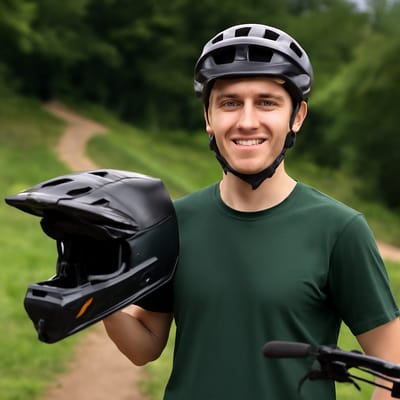
Downhill and bike‑park riding put your face, jaw, and teeth in play. That’s the headline reason a full‑face helmet exists. But an open‑face helmet can still be the right choice when your ride mixes long climbs, steady trail speeds, and only occasional downhill sections.
Open‑face (half‑shell): where it shines
- Better airflow at lower speeds and on climbs
- Lighter feel for long trail days
- Easier to take on/off during stops and train travel
- Often cheaper for a given level of safety tech
Full‑face: where it earns its keep
- Adds chin bar coverage for jaw/face impacts
- Typically offers more rear and side coverage
- Pairs naturally with goggles for rough descents
- Often designed around higher‑energy crash scenarios
The real decision is how often you’re actually riding gravity. If you’re doing uplift days, steep natural tracks, or bike‑park laps, a full‑face is usually the sensible default. If you’re mostly riding trail centres with only short steep drops, an open‑face can be a better all‑day solution.
There’s also a behavioural reality: beginners sometimes buy a full‑face “for safety,” then leave it at home because it feels hot or heavy. A helmet worn every ride beats a perfect helmet left on a hook. For a clean, side‑by‑side breakdown of protection, comfort, and use cases, mTB E‑Bike Helmet Styles: Full‑Face vs Open‑Face for Downhill is the dedicated comparison.
Two topics that deserve deeper treatment here are goggle compatibility and visor fit (small geometry differences can make goggles sit wrong), and how to choose a helmet that fits properly for MTB and e‑bike sessions, especially if you’re between sizes or wear thicker winter caps.
Which UK safety standards and certifications should you trust?
Safety labels can feel like alphabet soup, but you can use them to filter out risky purchases quickly. In the UK, you’ll typically see cycle‑helmet standards referenced, and sometimes additional marks depending on the helmet’s intended discipline. The key is understanding what a standard does well, and what it doesn’t promise.
What standards are (and aren’t)
A standard generally tests impact attenuation and retention (strap strength and how the helmet stays on). It does not guarantee you’ll avoid concussion, and it doesn’t perfectly model every downhill crash. Still, it’s your baseline for not buying a “stylistic” helmet with weak protection.
Rotational impact protection matters
Many real crashes involve twisting forces, not just straight hits. That’s why MIPS and similar systems matter for riders who prioritise head injury reduction. If you’re the type who reads test protocols and wants to understand what’s inside the liner, mIPS and Other Impact Protection Technologies Demystified explains the common technologies, what they try to do, and what trade‑offs (like fit and ventilation) can show up.
UK compliance and what to look for when shopping
If you’re comparing listings across UK retailers, check that the standard and intended use match your riding. Be cautious with marketplace imports where labelling is unclear or the seller can’t provide verifiable compliance information.
For a clear, UK‑specific breakdown of the most commonly referenced standards and what they mean in practice, safety Standards Explained: CE EN 1078, ANSI, and UK Compliance is the deep dive.
Safety‑conscious riders often ask whether a pricier helmet is automatically “safer.” Not always. Past a basic threshold, you’re frequently paying for comfort engineering, weight reduction, and features that help you keep the helmet on your head for longer rides.
Do shell materials like carbon fibre actually change safety?
Shell construction affects how a helmet manages impact energy, how it resists cracking, and how much it weighs. It also changes day‑to‑day wearability, which matters for e‑MTB riders doing longer sessions.
Common shell materials (and what you feel on the trail)
- Polycarbonate: common in value and mid‑range helmets; usually paired with EPS foam. It can offer great protection, but may weigh more for similar coverage.
- Fibre composite (fibreglass blends): often used in gravity‑leaning designs; can balance strength and weight.
- Carbon fibre: prized for low weight and stiffness. In practice, carbon shells are often about making a full‑coverage helmet feel less fatiguing.
Carbon fibre doesn’t magically “beat” every other shell in safety. The full system matters: EPS density, liner design, how the shell is bonded, and how the helmet fits your head shape. A well‑designed polycarbonate helmet can outperform a poorly designed carbon one.
Where carbon fibre helps downhill riders
If you’re choosing full‑face for downhill, dropping weight can reduce neck fatigue and make it easier to keep your head stable through rough sections. That can be especially relevant for UK riders stacking bike‑park laps or doing long natural descents in Wales, the Lakes, or Scotland.
A quick value lens for UK shoppers
- Paying more makes sense when it buys comfort you’ll notice every ride: stable fit, less lift at speed, better ventilation pathways.
- Be wary of “carbon look” marketing. What you want is clear material disclosure and reputable compliance labelling.
If you’re also comparing prices, the under‑£100 segment deserves its own careful discussion because compromises are not always obvious from photos. A dedicated guide to budget MTB helmets under £100 is worth reading before you assume all bargains are equivalent.
How do you get sizing, fit, ventilation, and comfort right?
Fit is the multiplier. Even an expensive helmet can underperform if it shifts on impact, sits too high, or creates pressure points that tempt you to loosen it. For beginners, the simplest rule is: snug everywhere, no hotspots, and it should stay put when you gently try to rotate it.
A practical fit check you can do in 2 minutes
- Tighten the retention system so the helmet feels secure without pain.
- Buckle the strap, then open your mouth wide; you should feel the helmet pull down slightly.
- Try to roll the helmet forward and back. If it moves easily, sizing or strap geometry is off.
Comfort factors that matter more on e‑MTB
- Ventilation: e‑MTB climbs can be slow and sweaty. Look for real air channels, not just lots of holes.
- Weight distribution: a slightly heavier helmet that sits balanced can feel lighter than a light helmet that tips forward.
- Pad management: removable, washable pads help with UK mud and year‑round riding.
Goggle fit is a common frustration in downhill setups. Small differences in brow shape, visor adjustability, and helmet opening can cause goggles to press into your nose or lift at speed. Goggle compatibility and visor fit deserve a dedicated guide because it’s one of the biggest “I didn’t expect this” problems after purchase.
If you’re prone to prioritising safety tech, remember it still has to fit your head shape. Some riders feel a slip‑plane system immediately, others never notice it. The best outcome is a helmet you forget about while riding, because it’s stable, cool enough, and not distracting.
Buying, maintenance, and lifespan: how to choose confidently
Once you know your style (full‑face vs open‑face) and your must‑have safety baseline, the purchase becomes a shortlist exercise. UK shoppers comparing helmet options and prices can avoid most regret by focusing on a few decision points.
What to look for when buying
- Intended use matches your riding: trail lids for trail days, downhill‑leaning lids for uplift and bike‑park laps.
- Verified safety marking and reputable seller: especially important with online marketplaces.
- Stable fit at your typical ride temperature: winter caps and summer sweat can change how a helmet sits.
- Impact protection tech: consider MIPS or similar if rotational protection is a priority.
- Real‑world wearability: ventilation, noise, visor adjustment, and goggle pairing.
Product tiers (brand‑neutral) that usually make sense
- Entry‑level: good for beginners learning what they like, but be strict on compliance and fit.
- Mid‑range: often the sweet spot for comfort, padding quality, and ventilation.
- Premium: pays off most for full‑face weight reduction, refined fit systems, and durable hardware.
Maintenance and replacement basics
Treat any significant impact as a replacement trigger, even if damage isn’t visible. EPS can be compromised internally. Also replace if the retention system is failing, straps are fraying, or the helmet no longer fits securely.
Helmet care matters in the UK because wet grit and sweat can degrade pads and hardware. Cleaning methods, storage (away from heat), and a realistic replacement schedule deserve their own focused discussion, especially for riders doing multiple sessions per week.
If you want to go deeper on the two most confusing parts of the buying decision, use these as your next steps: Safety Standards Explained: CE EN 1078, ANSI, and UK Compliance for the labels, and mIPS and Other Impact Protection Technologies Demystified for the tech inside the liner.
Frequently asked questions about MTB e‑bike helmets
Is a full‑face helmet always better for downhill e‑MTB?
Not always, but it’s often the safer default when you’re doing uplift days, bike‑park laps, or consistently steep descents. Full‑face adds chin and jaw coverage, but you must be willing to wear it for the whole ride.
I’m a beginner in the UK—should I start with open‑face or full‑face?
If you’re mostly riding trail centres and learning skills, an open‑face can be more comfortable and more likely to be worn every ride. If your plan includes regular downhill days, starting with a full‑face can make sense, provided it fits well and doesn’t overheat you.
Which safety standard should I look for when shopping in Great Britain?
Look for clear, verifiable compliance labelling from reputable UK retailers, and match the helmet’s intended use to your riding. If you’re unsure how to interpret labels, use a standards guide before you buy.
Do MIPS helmets make a real difference for safety‑conscious riders?
MIPS and similar systems aim to reduce rotational forces in certain impacts, which is why many safety‑focused riders prioritise them. The benefit depends on the crash, and fit still matters most because a shifting helmet can reduce protection.
What’s a realistic price range for a good MTB e‑bike helmet in the UK?
Entry‑level helmets can be workable if fit and compliance are solid, while mid‑range often brings better ventilation and more stable retention systems. Premium pricing usually buys weight reduction, refined comfort, and features that make full‑coverage helmets easier to live with.
How often should I replace my helmet if I ride year‑round in the UK?
Replace immediately after a significant impact, even if you can’t see damage. Otherwise, replace if the helmet no longer fits securely, the retention system is worn, or the padding and straps have degraded from heavy use.
Can I use the same helmet for trail rides and occasional downhill days?
Yes, many riders do, but be honest about the proportion of downhill and the speed/terrain you’re riding. If downhill days are frequent or high consequence, a dedicated full‑face is usually the more appropriate choice.
How do I know if my goggles and visor will fit a full‑face helmet?
Check the helmet’s eye port size, visor adjustability, and whether the goggle strap sits securely without slipping. Small shape differences can cause pressure points or gaps, so trying them together is ideal whenever possible.