MIPS Impact Protection: Helmet Tech Guide 2026
Breadcrumb
What is MIPS, and why do MTB/e-bike riders care?
MIPS (Multi-directional Impact Protection System) is a rotational impact protection technology designed to reduce certain brain-strain forces during angled impacts. In plain terms, many real crashes are not straight-on. Your helmet can hit the ground at a slant, and that can create twisting motion of the head. MIPS adds a low-friction slip layer inside the helmet so the shell and liner can move slightly relative to your head, helping redirect some rotational energy.
For UK MTB and e-bike riding, the “why” is practical: higher average speeds (especially on e-MTB climbs and transitions), mixed terrain, and frequent low-speed tip-overs all increase the chance of odd-angle impacts. Beginners often assume “harder shell = safer,” but impact management is more about how the whole helmet system handles energy.
MIPS is not a magic shield and it does not replace good fit. A poorly fitted MIPS helmet can still move too much, while a well-fitted non-MIPS helmet can still perform strongly in standard tests. Think of MIPS as an additional design feature that can help in specific crash dynamics.
If you’re still deciding between helmet types for downhill or bike-park riding, style and coverage matter alongside tech. The trade-offs are explained clearly in mTB E‑Bike Helmet Styles: Full‑Face vs Open‑Face for Downhill.
How does MIPS actually work inside the helmet?
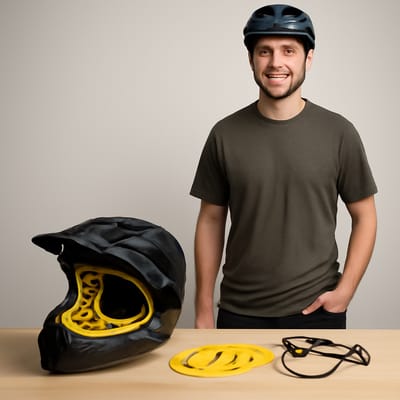
Most MIPS-equipped helmets include three core elements: a slip plane (often a thin plastic liner), attachment points (small elastomers or anchors), and controlled movement (usually about 10–15 mm) in certain directions during an angled impact. Under normal riding, you should not feel the helmet “floating,” but you may notice a slightly different feel when putting it on or adjusting straps.
What you should look for when trying one on
- No hot spots: the MIPS layer should not create pressure points on the forehead or crown.
- Stable retention: when you shake your head, the helmet should stay planted without wobble.
- Smooth adjustment: the fit system should tighten evenly, not pull the liner into your scalp.
Common misconceptions
- “MIPS means the helmet is certified.” Not necessarily. Certification depends on the standard the helmet is tested to.
- “Any MIPS helmet is safer than any non-MIPS helmet.” Real-world safety depends on fit, coverage, impact liner tuning, and the exact crash.
- “You need MIPS for e-bikes.” You need the right helmet for your riding, and MIPS may be a sensible extra for higher-speed or technical use.
To sanity-check the baseline safety requirements you should expect in the UK, pair any tech talk with standards knowledge. Safety Standards Explained: CE EN 1078, ANSI, and UK Compliance helps you interpret labels and avoid false confidence.
What other impact protection technologies exist besides MIPS?

MIPS is the best-known name, but it’s one approach to managing angled impacts. You’ll also see other rotational management systems and liner concepts that aim for similar goals with different engineering.
Common categories you’ll encounter
- Slip-plane systems (MIPS-style): a low-friction layer allows controlled movement between helmet and head.
- Shear-thickening pads or gels: materials that feel soft in normal use but stiffen under sudden force.
- Directional or dual-density EPS tuning: foam densities are tuned by zone to better manage different impact severities.
- Cellular liners (honeycomb-style): engineered structures compress progressively, sometimes improving repeat low-energy impact handling (varies by design).
How to compare them without getting lost
Use a simple checklist:
- Does it add bulk or heat? Ventilation matters on long climbs and e-bike transitions.
- Does it affect fit? If the tech changes head shape compatibility, it’s a deal-breaker.
- Is it paired with the right helmet style? Full-face vs open-face changes the coverage and weight equation.
- Is it backed by clear certification labeling? Standards are the floor; tech is the extra.
UK shoppers comparing options and prices should treat these technologies like you’d treat suspension features on a bike: useful, sometimes worth paying for, but only when they match your riding and body comfort. Pay attention to return policies and try-on time at home so you can evaluate pressure points and heat build-up realistically.
How to choose impact protection tech for your riding (UK buying guide)
Choosing MIPS or another impact protection system is easiest when you start from your riding profile and work outward.
Step 1: Match the helmet category to your risk
- Trail and mixed riding: open-face helmets with rotational protection can be a smart balance for many riders.
- Downhill/bike park: full-face coverage often matters as much as the liner tech.
- E-MTB commuting + light trails: prioritize comfort, visibility, and consistent use. The “best” tech is the one you’ll wear every ride.
Step 2: Use a practical budget ladder
- Entry level: focus on certified protection, good retention, and comfortable padding. Tech add-ons are a bonus.
- Mid range: rotational systems become common; expect better ventilation and fit adjusters.
- Premium: you’re paying for refined comfort, lower weight, and more sophisticated liner tuning.
Step 3: Confirm fit before paying extra for features
A safety-conscious rider evaluating certifications should treat fit as non-negotiable: the helmet should sit level, low on the forehead, and stay stable with straps snug. If you’re new to MTB/e-bikes, it’s worth spending more time dialing fit than comparing marketing names.
Finally, don’t let one feature decide everything. A rotational layer helps only if the helmet is worn correctly and suits your riding style, which is why the full-face vs open-face decision remains foundational for many downhill-focused riders.
Care, replacement, and “is MIPS still good after a crash?”
Impact protection technologies are not maintenance-heavy, but they are not “set and forget,” either. The main risk is keeping a helmet too long, or continuing to use it after a significant impact.
After any meaningful crash
- Replace the helmet if it took a hard hit, even if the shell looks fine. EPS foam can be crushed internally.
- Inspect the MIPS layer (or equivalent): look for torn anchors, warped slip liner, or anything that no longer sits flat.
- Check retention and straps: a cracked adjuster or stretched webbing can ruin stability.
Everyday care that preserves performance
- Clean with mild soap and water; avoid harsh solvents that can weaken plastics.
- Let it air-dry away from radiators or direct sunlight.
- Store it where it won’t be crushed (common issue in car boots with tools and pumps).
Replacement timelines
Many manufacturers suggest replacement after several years of regular use. For e-bike riders who rack up frequent weekly mileage, sweat, UV exposure, and repeated handling can age pads and retention faster.
A final reality check: no technology compensates for a helmet that shifts on your head. If you find yourself constantly re-adjusting, it’s a fit or sizing problem first, not a “needs more tech” problem.
FAQ: MIPS and impact protection technologies
Is MIPS worth it for beginners riding UK trails?
Often, yes, if it doesn’t compromise fit or comfort. Beginners tend to have more low-speed falls and awkward angles, where rotational management may help. Still, a well-fitting certified helmet is the priority.
Does MIPS make a helmet compliant with UK safety standards?
No. MIPS is a technology feature, while compliance comes from testing to a standard and correct labeling. Always check the helmet is certified for the use case you’re buying it for.
How can I compare MIPS vs other rotational impact protection systems?
Compare comfort, ventilation, stability, and certification first, then look at how each system manages angled impacts (slip plane, pads, cellular liners). If you can’t keep the helmet stable on your head, the differences matter less.
Will a MIPS helmet feel different when I put it on?
Sometimes. You may notice a slightly slicker feel or a thin liner layer inside, but it should not create pressure points. If it feels like it’s sliding around during normal wear, sizing or adjustment is off.
Is MIPS more important on a full-face MTB/e-bike helmet?
Full-face coverage can reduce injury risk in different ways (jaw/face protection), while MIPS targets certain rotational forces. For downhill and bike-park riding, you usually want both good coverage and good impact management, balanced with heat and weight.
Do I need to replace a helmet after a small knock, even with MIPS?
If it’s a minor tap with no force, usually not. After any hard impact or crash where your head hit the ground, replacement is the safe call because foam can be damaged invisibly.
How do UK shoppers judge whether the extra cost for MIPS is justified?
Tie the spend to your riding: higher speeds, technical terrain, or frequent riding days make the upgrade easier to justify. If your budget is tight, prioritize a certified helmet with excellent fit and stable retention before paying more for added tech.